Research
Risk prediction
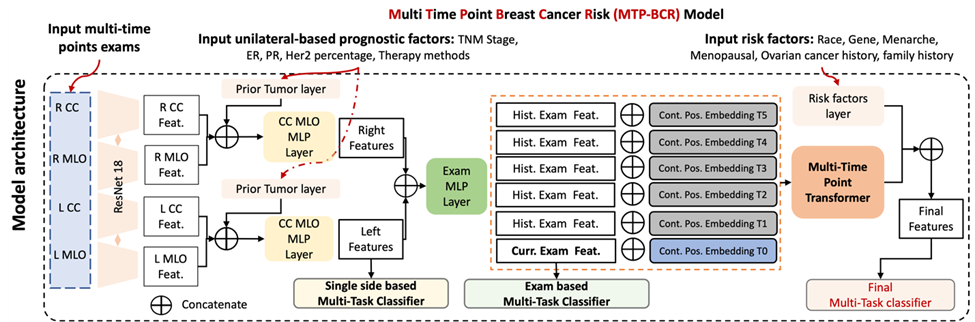
Project 1. Predicting up to 10 year breast cancer risk using longitudinal mammographic screening history
Recent deep learning (DL) risk models based on mammography have shown superiority in short-term risk prediction compared to traditional risk factor-based models. However, those models primarily rely on single-time exams and thus ignore the temporal changes in breast tissues that can be extracted from sequence exams. Here, we present the Multi-Time Point Breast Cancer Risk Model (MTP-BCR) a novel temporospatial DL risk model that integrates traditional BC risk factors and longitudinal mammography data to identify subtle changes in breast tissue indicative of future malignancy.
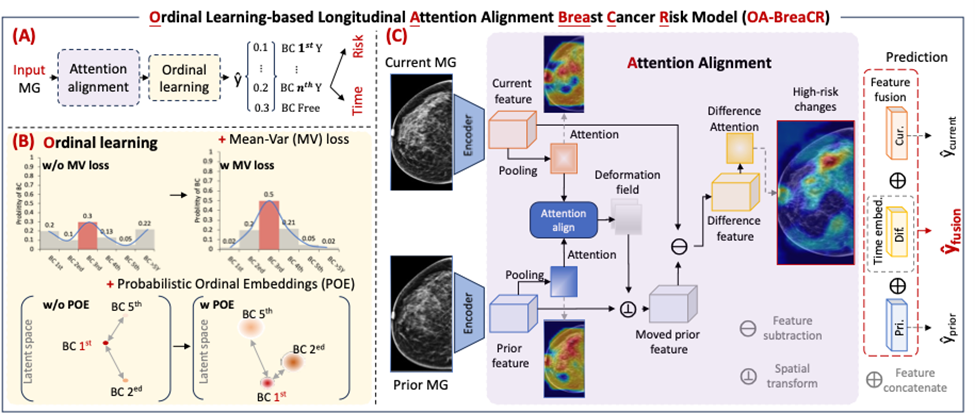
Project 2. Ordinal Learning: Longitudinal Attention Alignment Model for Predicting Time to Future Breast Cancer Events from Mammograms
Rethinking the mammogram based risk prediction model: precision and explainability are vital in breast cancer risk assessment for developing personalized screening and prevention strategies. We introduce OA-BreaCR, a method that precisely evaluates both the likelihood and timing of future breast cancer occurrence using sequential mammograms. To enhance Precision: By employing ordinal learning, OA-BreaCR models temporal information based on the 'time-to-future-event' ordering among patients, improving the precision of time predictions. To improve Explainability: The method utilizes an attention alignment mechanism to effectively track high-risk breast tissue changes over time, enhancing the model's interpretability.
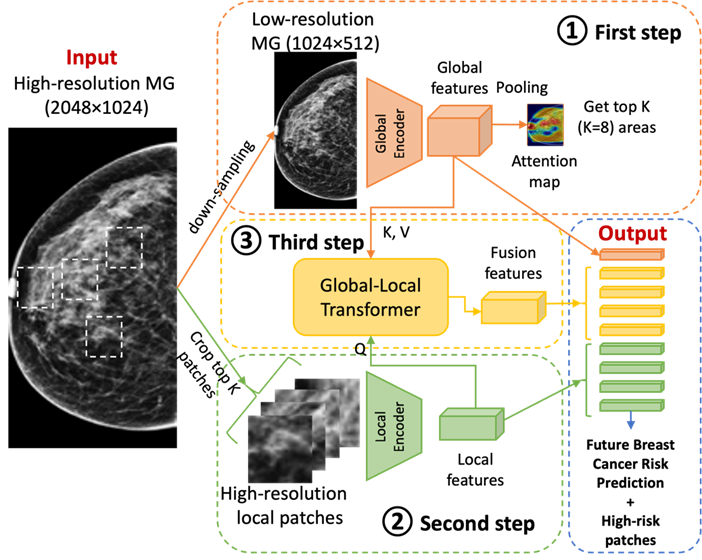
Project 3. Global-local learning for explainable breast cancer risk prediction from screening mammograms
To mimic the process of mammogram reading by radiologists, which firstly figure out globally high-risk characteristics (e.g. dense tissue, architectural distortion et al.), and then further analyze the local suspicious areas (such as micro-calcifications), we propose a global-local transformer framework-based (GL) risk prediction model.